Next useful tasks
- Curate the first visual walk
- Test contribution pathways
- Accessibility and stewardship review
A living vision commons · envisioned condition
A visual walk, working roadmap, and open-ended register of people, projects, places, skills, and seeds.
Concept visualization · not a completed site
Möbius Refuge · Oiko Ways
This work addresses homelessness and poverty by helping build conditions for safe, accessible housing, shared capacity, friendship, livelihood, and community.
No one has to disclose crisis, accept a label, or understand the whole system before entering. A person can arrive through beauty, curiosity, a practical skill, a need, a project, a place, or a question.
No one carries the whole weight. Friendship is more than proximity: it can be the practice of helping one another carry what is too large for one life while preserving agency, boundaries, and responsibility.
Bloomscrolling · the narrative spine
Enter where something catches. Open a tributary. Add a seed. Return differently.
Arrive without proving anything.
Leave a note, question, story, seed, or invitation.
Move knowledge between people through making.
Grow food, habitat, care, and local capacity.
Make home + habitat playable before it becomes buildable.
Circulate goods, resources, and livelihoods.
Test a question worth learning from.
Move learning among sites and people.
Practice shared place without forced sameness.
Let the network precede the village.
Return Neighbor → Mail → Guild → Garden → Homitat → Market → Lab → Residency → Village → Network → Neighbor
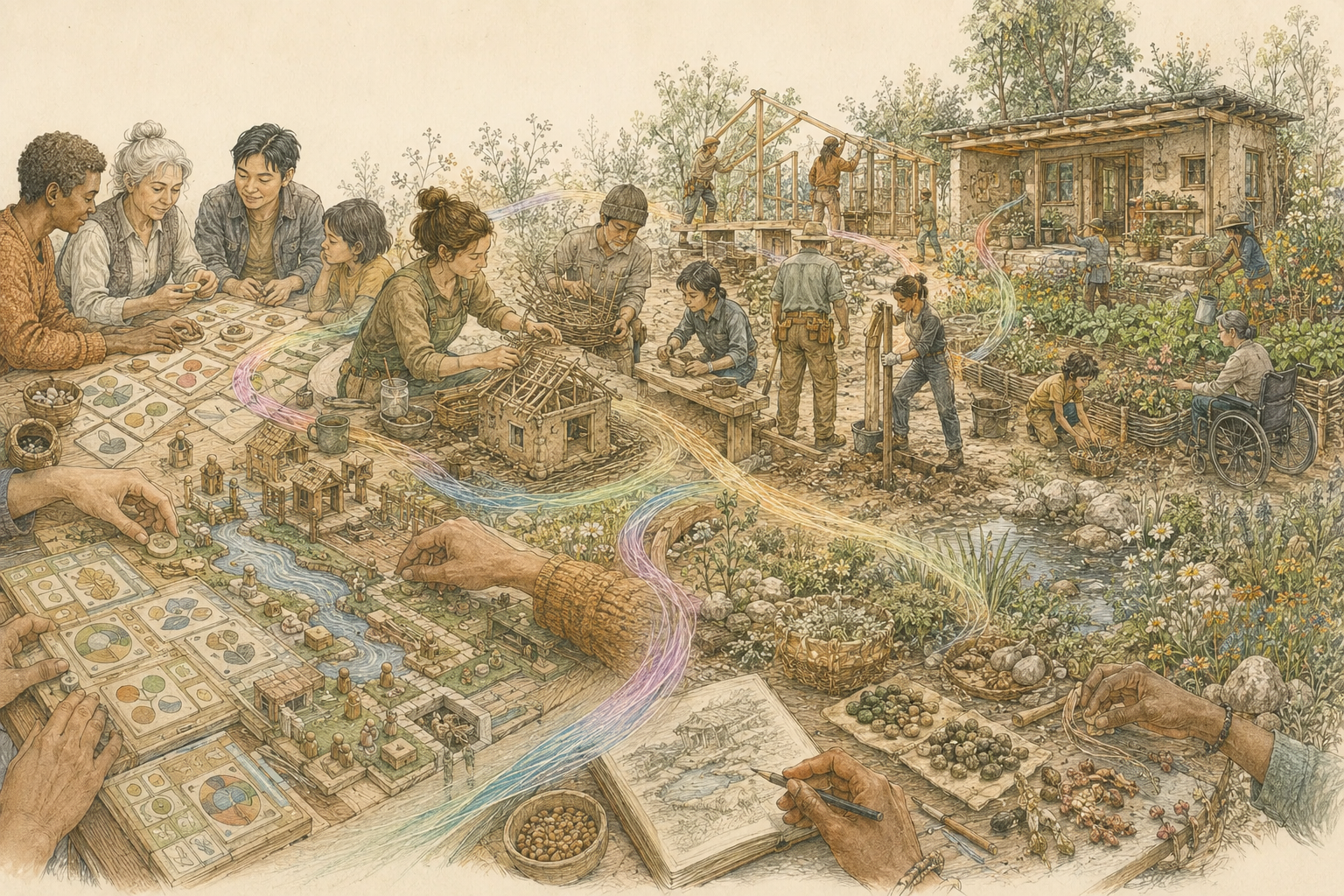 Concept visualization · game → practice → stewardship → possible inhabitation
Homitat · play before build
Drawing from tabletop gaming, community practice, game theory, and art as education, Homitat uses cards, scenarios, maps, and handmade dioramas to make a complex living system visible and revisable.
Participants can make choices, encounter consequences, practice facilitation, and strengthen agency before learning moves toward model-scale design-build, embodied making, landscape stewardship, or possible inhabitation.
Read the developing pathway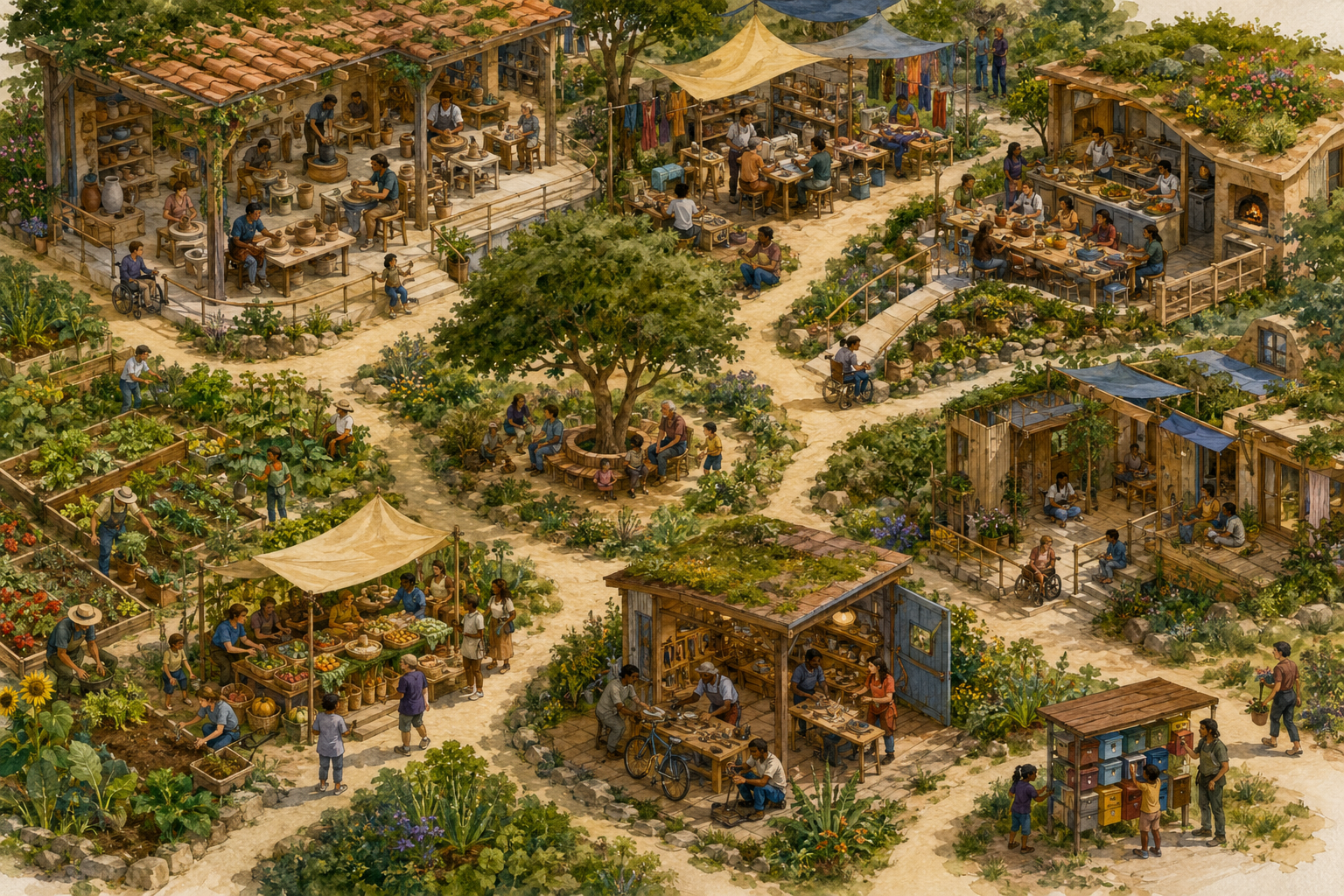 Concept visualization · a possible connected ecology
The tributaries
A repair table, garden, housing idea, craft circle, research question, free mailbox, or neighborhood project can keep its own name and authorship while becoming visible in relation to others.
From vision to coordinated work
Each project shows its current state, next useful tasks, and the roles that can move it forward. Status is honest; invitation is specific.
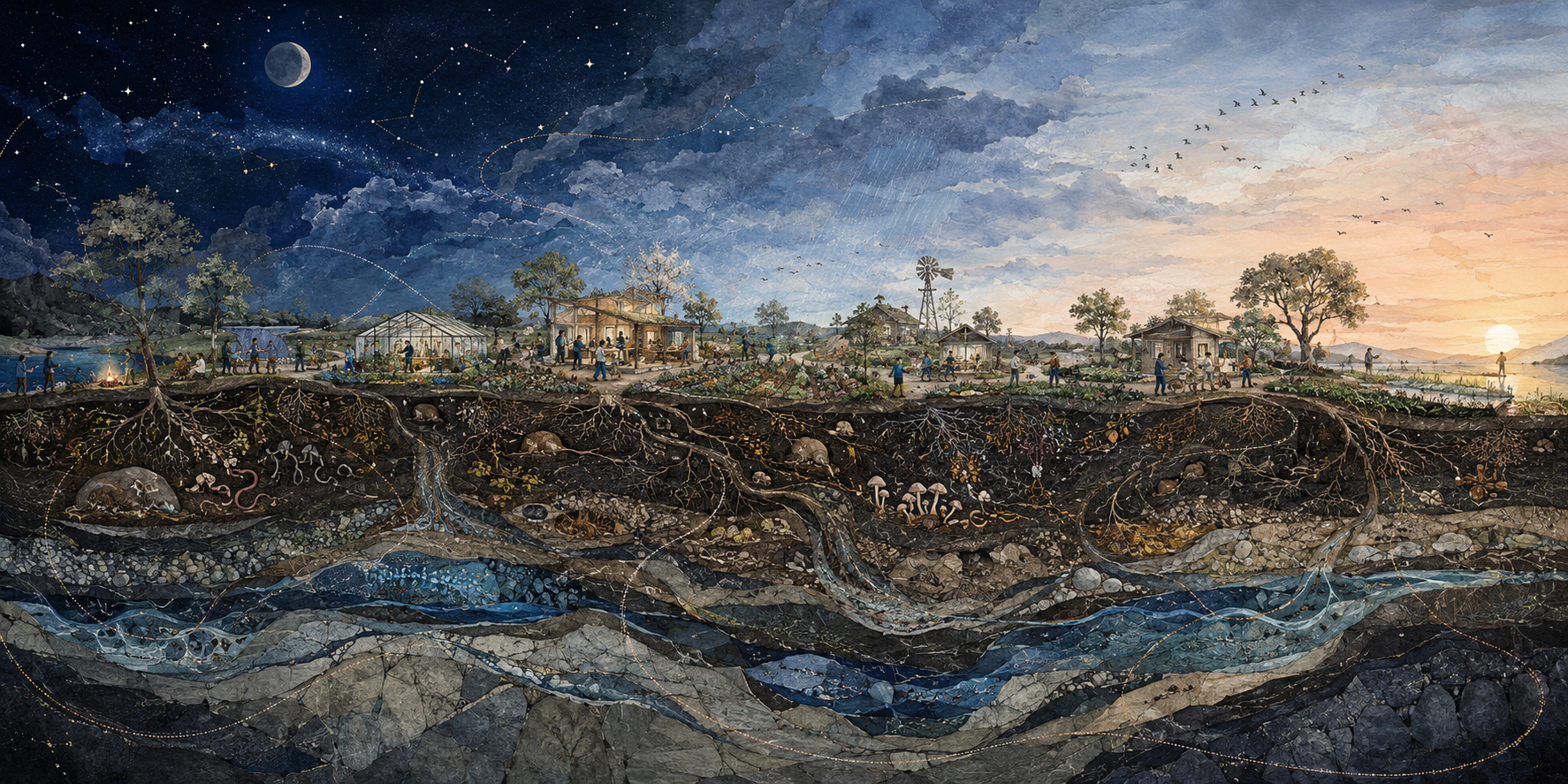 Concept visualization · scientific-poetic orientation
Professionals · peers · patrons · neighbors
You do not have to become a member of an institution. You can participate in an ecology—briefly, repeatedly, professionally, playfully, or over a long arc.
Notice what is here. Leave Mail. Name a local condition or possibility.
Choose this wayReview a framework, share adjacent work, or connect a small project without surrendering its identity.
Choose this wayOffer a bounded review in housing, project management, accessibility, ecology, design, law, finance, or care.
Choose this wayTeach, repair, prototype, host a station, or propose a guild.
Choose this wayOffer a site, room, garden, workshop, gathering, or learning context.
Choose this wayFund materials, access needs, paid stewardship, documentation, land, or a pilot.
Choose this wayHelp receive, curate, credit, connect, document, and return learning to the commons.
Choose this wayParticipation with stewardship
Contributions are received privately, reviewed, clarified, credited by choice, and only published with permission. Participation does not require surrendering stewardship—and stewardship does not create ownership of another person’s work.
Leave Mail · sign the living guestbook
You do not need a polished proposal. Name what caught you, what you carry or grow, what it might connect to, and how you might like to return.
“Be worthy of the trust of thy neighbor, and look upon him with a bright and friendly face.”— Bahá’u’lláh, Kitáb-i-Aqdas, ¶148